Nonprofit
Debt Relief
Certified

HUD-Approved Housing Counseling Agency

NFCC Member

501(c)(3) Nonprofit
.webp)
.svg)
.webp)
.svg)
.webp)


.svg)


.svg)

.svg)
.svg)
No Obligation
No Pressure

.svg)


.svg)


.svg)


.svg)
.svg)
Starting Point
…here's what happens depending on how you choose to pay it back.
estimated total amount paid
Most Costly
Nearly 3× your original debt — most of it interest.
estimated total amount paid
Months to pay off
30+ years
Interest accrued
extra cost
Total paid
vs $15,000 owed
Better Option
Requires good credit to qualify for favorable terms.
estimated total amount paid
Months to pay off
5 years
Interest accrued
extra cost
Potential savings vs minimum payments
Best Result
The most effective path — lowest total cost, same timeline as a loan.
estimated total amount paid
Months to pay off
5 years
Interest accrued
extra cost
Potential savings vs minimum payments

Explore debt relief tools and resources or connect with a certified counselor for personalized guidance.


Always Free
No Obligation
Confidential

For Educational Guidance


Estimated Available Equity

Estimated Monthly Payment Option

Interest Rate Range

Speak with a certified housing counselor to review your situation, questions, and next steps.
.svg)
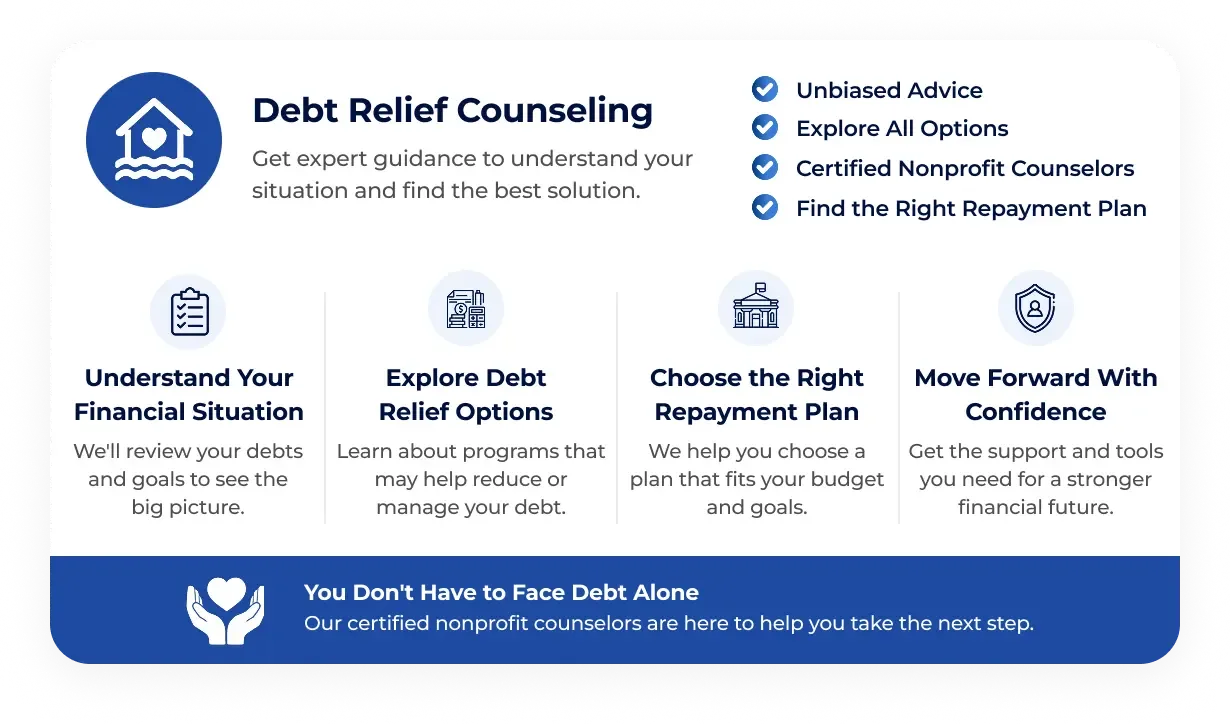
Debt relief covers any strategy that reduces or restructures what you owe: budgeting and a self-directed payoff plan, a debt management plan, debt consolidation, or debt settlement, each targeting unsecured debt like credit cards and personal loans, not your mortgage or car loan. During counseling, a certified counselor reviews your actual numbers, explains what each option really costs and how long it takes, and helps you pick a next step instead of guessing.
.svg)
The initial counseling session is free. Credit counseling looks broadly at your credit, budget and overall financial health, while debt counseling places greater emphasis on your debt obligations and repayment options. If a Debt Management Plan is recommended and you choose to enroll, applicable program fees will be fully explained before enrollment.
.svg)
Bring your income, monthly expenses, and credit card balances so we can create a personalized action plan together.
.svg)
That's okay! You can schedule a time that fits your day or reach out later when you're ready to take the first step.
.svg)
A nonprofit credit counseling agency has no financial stake in which option you pick, unlike a debt settlement company that only gets paid if you enroll. At Credit.org, your counselor reviews your budget, debts, and credit, walks through debt management, debt consolidation, and debt settlement as real options, and helps you build a plan around whichever one actually fits, including a Debt Management Plan when that's the right call.
.svg)
The counseling session itself has no impact on your credit. What you do afterward does: enrolling in a Debt Management Plan usually doesn't hurt your score much since you keep paying your creditors, while debt settlement almost always requires you to stop paying for a while, which can drop your score significantly before it recovers.
Some are legitimate, but the industry has a real reputation problem, so it's worth knowing your rights. By law, a debt settlement company can't charge you any fee until it has actually settled at least one of your debts and you've made a payment under the new agreement, so if a company wants money upfront, that's an immediate red flag. Debt settlement also usually means you stop paying creditors while the company negotiates, which can mean collection calls and credit damage in the meantime, and there's no guarantee a creditor agrees to settle at all. A nonprofit counselor can help you weigh that risk against a Debt Management Plan before you sign anything.


Private & confidential

Educational guidance

HUD-approved agency

No sales pressure




.svg)
.svg)